



How to Calculate the ROI of a Fleet Wrap (With Real Numbers)
How to Calculate the ROI of a Fleet Wrap (With Real Numbers)

How to Calculate the ROI of a Fleet Wrap (With Real Numbers)
If you run a business with vehicles on the road, you've probably been pitched on fleet wraps as "the best advertising investment you can make." Whether that's actually true depends on numbers most shops don't bother to walk you through. This post does the math.
We'll show you exactly how to calculate the return on a fleet wrap for your specific business — what variables actually matter, what numbers to use, how to track it after install, and worked examples for four different business types. By the end, you'll be able to plug your own numbers in and decide whether a wrap is the right move for you, or whether a different ad channel makes more sense.
The Four Variables That Drive Fleet Wrap ROI
Every honest ROI calculation comes down to four numbers. Get these right and the math is straightforward.
Daily impressions. How many people actually see your vehicle each day. This depends on miles driven, routes, traffic density, and whether the vehicle is parked at job sites or moving constantly.
Wrap cost. What you pay for design, materials, and install. For a typical service van in the Denver market, this is usually $3,500 to $5,500.
Wrap lifespan. How long the wrap stays in good condition before needing replacement. Premium cast vinyl wraps from 3M or Avery Dennison typically last five to seven years in Colorado conditions. We'll use five years as a conservative baseline.
Conversion rate and customer value. What percentage of people who see your wrap actually become customers, and what each of those customers is worth to your business over time.
The first two are easy. The last two are where most ROI calculations get sloppy. Let's go through each one carefully.
Estimating Daily Impressions Honestly
Marketing companies love citing the OAAA (Outdoor Advertising Association of America) study that suggests vehicles can generate 30,000 to 70,000 daily impressions. That ceiling is real for high-mileage vehicles on dense urban routes, but it's not realistic for most service businesses.
Here's a more honest framework based on how your vehicle is actually used:
A stationary vehicle parked at job sites in residential or commercial areas generates roughly 1,000 to 5,000 impressions per day. The vehicle isn't moving, but neighbors, passing drivers, and pedestrians see it for hours.
A service van running 80-150 miles per day on metro Denver routes typically generates 8,000 to 20,000 daily impressions. This is the most common pattern for HVAC, plumbing, electrical, pest control, and similar trades.
A delivery vehicle running 150-300 miles per day on dense routes generates 20,000 to 40,000 daily impressions.
A highway-driven vehicle (long-haul, regional delivery, mobile services traveling between cities) can hit 30,000 to 60,000+ daily impressions because of the volume of traffic on I-25, I-70, and Denver's beltways.
For most local Front Range businesses, 10,000 to 20,000 daily impressions is the realistic range. Use that as your baseline and adjust based on how your vehicle is actually used.
The Basic ROI Formula
Once you have the four variables, the math is straightforward:
Cost per thousand impressions (CPM): Wrap cost ÷ (daily impressions × days × years × 1,000)
Worked example with conservative numbers:
- Wrap cost: $4,500
- Daily impressions: 12,000
- Days per year: 250 (working days, conservative)
- Wrap lifespan: 5 years
- Total impressions: 12,000 × 250 × 5 = 15,000,000
- CPM: $4,500 ÷ 15,000 = $0.30 per 1,000 impressions
That's the cost-per-impression number. Now compare it to what you're paying for impressions on other channels.
CPM Comparison: How Wraps Stack Up
The honest CPM (cost per thousand impressions) ranges in the Denver market roughly look like this:
- Billboard advertising: $5 to $15 CPM
- Local TV advertising: $10 to $30 CPM
- Local radio: $4 to $10 CPM
- Direct mail: $20 to $80 CPM
- Google Ads (display network): $2 to $10 CPM
- Facebook/Instagram ads: $5 to $15 CPM
- Fleet wraps: $0.10 to $0.50 CPM
Even adjusting generously for the fact that wrap impressions are passive (people see your van for two seconds in traffic vs. actively engaging with a Facebook ad), the cost-per-impression difference is enormous. A fleet wrap delivers impressions for roughly 1-3% of the cost of comparable outdoor advertising channels.
That's the structural argument for wraps. The ROI question is whether those cheap impressions actually convert.
The Conversion Math
This is where most ROI calculations fall apart. People multiply impressions by some made-up conversion rate and produce a fantasy number. The honest approach is to flip the math: figure out how many new customers you need to break even, and then ask whether that's a realistic number.
Break-even formula: Wrap cost ÷ Average customer lifetime value = Customers needed to break even
Worked example for an HVAC company:
- Wrap cost: $4,500
- Average customer LTV: $1,200 (one new install plus 5 years of maintenance)
- Customers to break even: 4 customers — over five years
That's less than one new customer per year to make the wrap pay for itself. For a wrapped van running residential routes in metro Denver and generating 12,000+ daily impressions, picking up four new customers across five years isn't optimistic — it's almost certainly conservative.
Worked example for a plumbing company:
- Wrap cost: $4,500
- Average job value: $400
- Average customer makes 2 repeat calls over 5 years
- Customer LTV: $1,200
- Break-even: 4 new customers across 5 years
Same math, similar conclusion. The wrap pays for itself in low single-digit new customers spread over its life.
Worked example for a landscaping company:
- Wrap cost: $4,500 (truck) + $2,500 (trailer) = $7,000 total
- Average customer LTV: $3,000 (annual contract value × average retention)
- Break-even: 3 customers across 5 years
The trailer wrap actually improves the math here because it dramatically increases impressions during job-site work without much additional cost.
Worked example for a food truck:
- Wrap cost: $5,500 (full wrap)
- Average customer purchase: $15
- Customers needed to break even: 367 — over the life of the wrap
A working food truck does 100+ transactions per service day. The wrap pays for itself in days, not months.
How to Actually Track ROI After Install
The biggest mistake businesses make is wrapping their fleet and never measuring whether it's working. Two simple tracking methods solve this completely.
Use a unique phone number on the wrap. Tracking numbers cost $5-15 per month from services like CallRail, Twilio, or similar providers. Put a unique number on the wrap that forwards to your main line. Now every call from the wrap is measured automatically. After three months of data, you'll know exactly how many calls per month the wrap generates — and whether your CPM math is conservative or aggressive.
Use a dedicated landing page URL. Instead of putting your main website on the wrap, use a clean URL like yourcompany.com/quote or vans.yourcompany.com that redirects to your main site. Track that URL in Google Analytics. You'll see exactly how many wrap-driven website visits you get and how many become leads.
Ask new customers how they heard about you. Low-tech, but it works. Train whoever answers the phone or schedules jobs to ask "How did you find us?" and log the answer. The wrap will start showing up consistently within a few months of install.
The combination of these three methods gives you real data — not estimated impressions, but actual calls, visits, and customers attributed to the wrap. After year one, you'll have honest numbers to evaluate whether to wrap additional vehicles.
Things That Boost Wrap ROI
A few decisions during the wrap process meaningfully improve return on investment.
Big, readable phone numbers. The single most common mistake is making contact info too small. Phone numbers should be readable from 50 feet away. We see wraps where the phone number takes up 20% of the side panel — those are the wraps that generate calls.
A clear value proposition in three seconds. What you do, who you serve, and why they should call. "Denver HVAC — Repairs & Installs — Same Day Service — 303-XXX-XXXX" reads instantly. A paragraph of services in 12-point font does not.
Strategic vehicle placement. Park visible vehicles at job sites, at customer locations, and at high-visibility lots when not in use. A wrapped van parked at a residential job site for six hours generates massive neighborhood awareness — neighbors who'll call you when they need the same service.
Consistent fleet branding. A fleet that looks unified signals professionalism and scale. Three trucks with the same wrap design generate more impact than three different-looking vehicles, even if those vehicles each get individually quality wraps.
Wrapping trailers. If your business pulls trailers, wrap them too. Trailer wraps cost less than vehicle wraps, dramatically increase impressions during work hours, and unify your brand across the entire rig.
Things That Hurt Wrap ROI
A few decisions tank the math, and we see them constantly.
Cheap vinyl that fails early. A budget wrap that fails in two years effectively doubles your CPM because you're paying twice. Always use premium cast vinyl from 3M, Avery Dennison, or KPMF on fleet vehicles. The labor cost is the same, and the longevity difference is enormous.
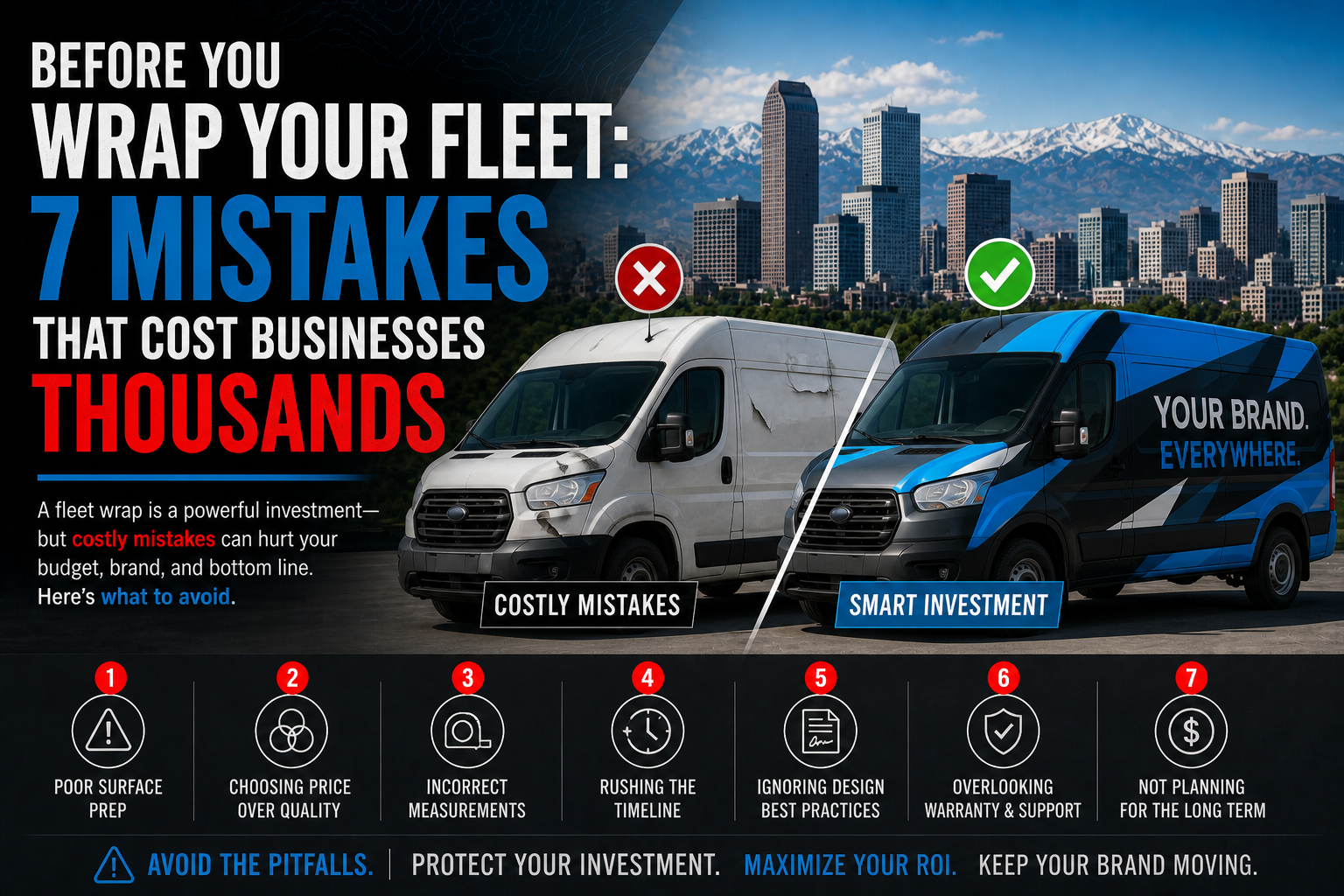
Bad design. A wrap nobody can read is a wrap that doesn't generate calls. Cluttered designs, low-contrast color choices, and tiny phone numbers waste the impression entirely.
No tracking. Without unique phone numbers, dedicated URLs, or attribution questions, you can't measure ROI and you can't optimize future wraps. Most fleets we work with have no idea how their wraps are actually performing.
Wrapping the wrong vehicles. A vehicle that lives in a garage 90% of the time isn't generating impressions. A vehicle parked in a back lot during the day isn't generating impressions. Wrap the trucks that are actually on the road in front of customers.
Hiding contact info. Putting your phone number on a back panel where it's only visible from one angle, or burying it in small text, kills the conversion rate. Phone numbers should be on every visible side of the vehicle.
Putting It All Together: A Quick ROI Worksheet
Here's the simplified version you can run for your own business:
Step 1: Estimate daily impressions based on how your vehicle is used. Use 8,000-15,000 for typical service van use, 20,000+ for delivery routes, 30,000+ for highway driving.
Step 2: Calculate total impressions: Daily impressions × 250 working days × 5 years.
Step 3: Get a real wrap quote for your vehicle.
Step 4: Calculate CPM: Wrap cost ÷ (Total impressions ÷ 1,000).
Step 5: Calculate break-even customers: Wrap cost ÷ Average customer lifetime value.
Step 6: Ask honestly — is generating that many new customers across five years realistic for your business?
For almost every service business in metro Denver, the answer is yes. For some businesses (highly niche B2B services with very narrow customer profiles, businesses that serve only by appointment from a specific location), the math may not work, and that's worth knowing before you spend the money.
Frequently Asked Questions
What's a realistic daily impression number for a service van in Denver? For a vehicle running typical residential and commercial service routes, 10,000 to 20,000 daily impressions is realistic. Vehicles that mostly stay parked at one job site for the full day generate fewer; vehicles running across the metro on multiple service calls generate more.
How long does it take for a wrap to generate measurable ROI? Most service businesses see new wrap-attributed customers within the first 30-60 days of install. Full break-even on a $4,500 wrap typically happens in 6-12 months for businesses with average customer LTV of $1,000+.
Is it worth wrapping older vehicles? Generally yes, if the vehicle has at least three to four years of expected service life remaining. The wrap doesn't depend on vehicle age — it depends on how much you'll drive it. A 2018 van with 80,000 miles that you'll keep until 2030 is a great wrap candidate.
Can I deduct the wrap as an advertising expense? Most fleet wraps qualify as advertising expenses for tax purposes, meaning the cost is generally deductible in the year incurred. Confirm with your CPA, but this is a meaningful piece of the ROI math for many business owners.
What if I don't have a fleet — just one vehicle? The math still works. A single wrapped vehicle for a small business often delivers better ROI per dollar than a multi-vehicle wrap because the cost is lower while the local-market impressions are still high. Solo operators in trades — handymen, mobile mechanics, tutors, dog walkers — frequently see exceptional returns from wrapping a single vehicle.
How does a partial wrap compare to a full wrap on ROI? Partial wraps cost roughly 40-60% of a full wrap and generate roughly 70-80% of the impression value if designed well. For tight budgets, partials often hit the better ROI per dollar. For maximum impact and brand consistency, full wraps win.
Run the Numbers for Your Business
Fleet wraps work for most local service businesses because the math structurally favors them: very low cost per impression, multi-year lifespan, and steady accumulation of brand awareness in your actual service area. But the math only works if the wrap is well-designed, well-installed, and tracked properly.
If you want help running the actual numbers for your specific business, we'll do it with you. Send us your vehicle types, your typical routes and miles driven, your average customer value, and we'll put together a realistic ROI projection plus a wrap quote — no obligation.
We work with businesses across Denver, Commerce City, Thornton, Aurora, Westminster, and the rest of the Front Range, and we'll tell you straight whether a wrap is the right call for your specific situation, what kind of return to expect, and what to track to confirm the math after install.