

Before You Wrap Your Fleet: 7 Mistakes That Cost Businesses Thousands
Before You Wrap Your Fleet: 7 Mistakes That Cost Businesses Thousands
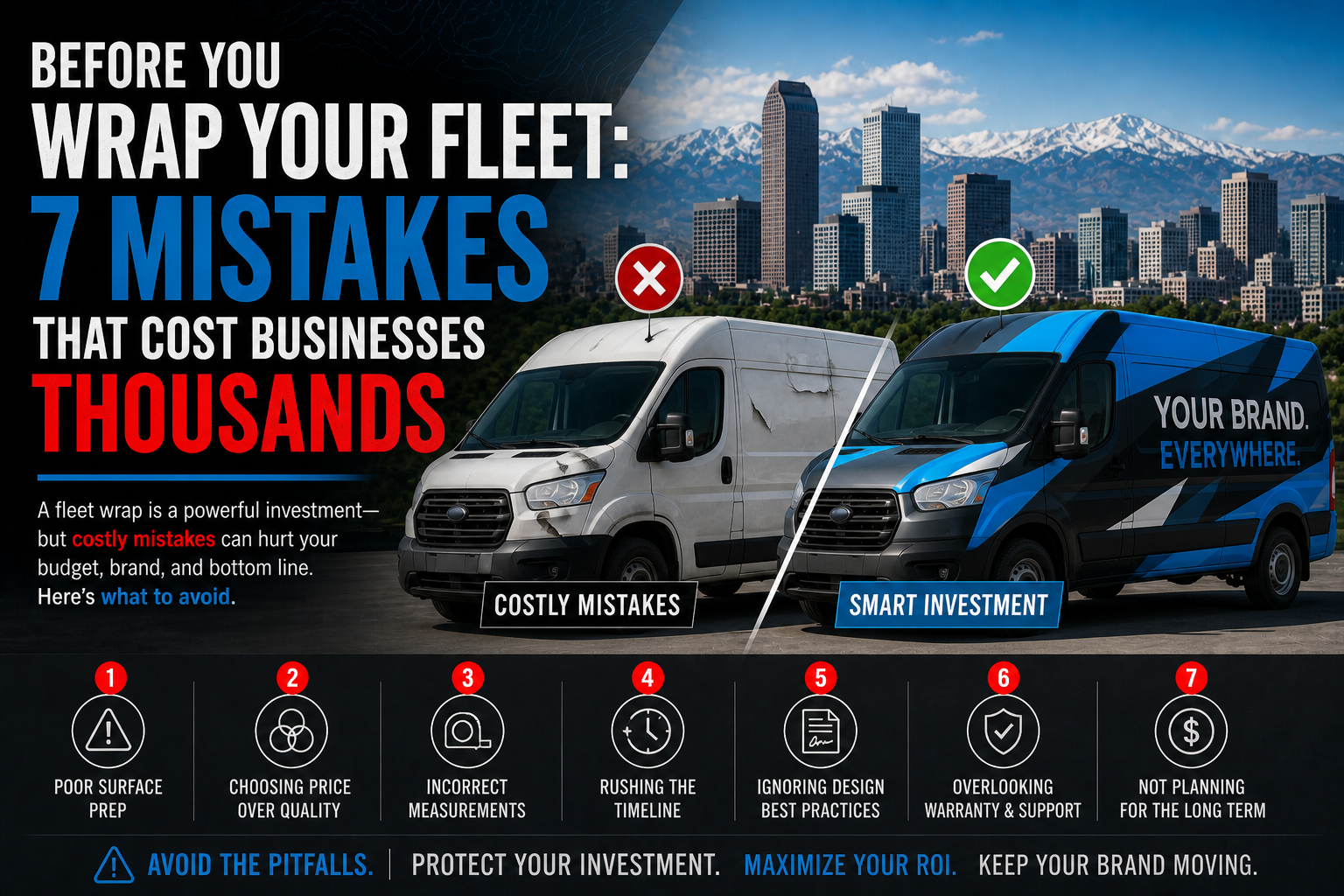
A fleet wrap is one of the highest-ROI marketing investments a local business can make — when it's done right. When it's done wrong, it costs you twice: once for the wrap that fails, and again to fix or replace it. We've seen businesses across the Front Range spend $4,000 on a wrap that failed in 18 months, then come back to do it correctly the second time around. That's not a marketing investment. That's a $4,000 lesson.
This post covers the seven mistakes we see most often, what each one actually costs, and how to avoid them before you ever sign a contract.
Mistake #1: Choosing the Lowest Quote Without Looking at What's Included
The temptation to go with the cheapest quote is real, especially when you're wrapping multiple vehicles and the savings add up. The problem is that "fleet wrap" is not a standardized product. Two quotes can be 30-40% apart on price and represent completely different products.
The cheap quote almost always involves one or more of these shortcuts: calendered vinyl instead of cast vinyl, no laminate top layer, lower-quality printing, less prep time, and inexperienced installers. Calendered vinyl shrinks, cracks, and fades within two to three years in Colorado conditions. Cast vinyl from 3M or Avery Dennison lasts five to seven years.
What it costs you: A $3,000 budget wrap that fails in two years costs you $6,000 over five years — once for the original install, again for the replacement. A $4,500 quality wrap lasts the full five-plus years. The "expensive" option is actually cheaper per year of service.
How to avoid it: When comparing quotes, ask three specific questions. What brand and series of vinyl are you using? Is the wrap laminated? What's the manufacturer warranty period and what does it cover? Quality shops will answer all three immediately. Shops cutting corners will get vague.
Mistake #2: A Cluttered Design That Nobody Can Read
The most expensive wrap in the world is worthless if drivers can't process the information in three seconds. We see this constantly: businesses cram every service, every certification, every social media handle, a value proposition, and tiny contact information onto the side of a van. The result is a busy graphic that nobody reads — and a wrap that doesn't generate calls.
Drivers passing your vehicle on I-25 have roughly three seconds to process what they see. In that window, they need to know three things: what you do, who you are, and how to reach you. That's it. Everything else is decoration that hurts the design's ability to do its job.
What it costs you: A typical service business that gets even five fewer wrap-attributed calls per year than they could because the design is unreadable is leaving thousands of dollars in customer lifetime value on the table. Over a five-year wrap life, a poorly designed wrap can cost $20,000-50,000+ in unrealized revenue compared to a clean, readable design.
How to avoid it: Apply the three-second test before approving any design. Hold the mockup at arm's length, look at it for three seconds, then look away. Can you remember what the company does and the phone number? If not, the design needs to be simplified. Phone numbers and websites should be the largest text after the logo and readable from at least 50 feet away.
Mistake #3: Wrapping Over Damaged Paint Without Addressing It First
Wraps adhere to the surface they're applied to. If that surface is sound factory paint or a quality repaint, the wrap bonds well and removes cleanly years later. If the surface is failing — peeling clear coat, active rust, previous repaint with adhesion issues, or aftermarket coatings that haven't fully cured — the wrap can pull paint off when removed, leave permanent damage, or fail to adhere properly in the first place.
We see business owners try to "hide" paint damage under a wrap because it's cheaper than bodywork. Sometimes it works. Often it doesn't, and the damage gets worse under the vinyl while you can't see it. By the time you remove the wrap five years later, you have a much bigger paint problem than you started with.
What it costs you: Repaint and bodywork after a failed wrap install can run $2,000-8,000+ per vehicle, on top of the wasted wrap cost and labor. Worst case, the vehicle's resale value takes a permanent hit because the original paint is no longer original.
How to avoid it: Have your shop inspect every vehicle before quoting the wrap. Issues like peeling clear coat, surface rust, recent repaints (less than 60-90 days old), and visible adhesion problems all need to be addressed first. A reputable shop will flag these before you ever pay a deposit. If the shop doesn't inspect, that's a warning sign.
Mistake #4: No Tracking System — So You Have No Idea If It's Working
This is the most common mistake, and the most expensive in terms of opportunity cost. Most fleet owners install wraps, hope they work, and never measure whether they actually generate business. After year one, they have no data to evaluate ROI, optimize future wraps, or justify additional investment in the marketing channel.
The fix takes 30 minutes and costs $5-15 per month per vehicle.
What it costs you: Without tracking, you can't tell which vehicles are generating calls, which design elements are working, or whether the wrap channel as a whole is profitable. Businesses commonly under-invest or over-invest in fleet wrapping by 30-50% because they're guessing instead of measuring. If wraps are working better than you think, you're missing growth. If they're working worse than you think, you're throwing money at the wrong channel.
How to avoid it: Three simple tracking methods, used together, give you everything you need.
First, put a unique tracking phone number on the wrap that forwards to your main line. Services like CallRail or similar providers cost $5-15/month and log every call automatically. Second, use a dedicated landing page URL on the wrap (yourcompany.com/quote, for example) and track visits to that URL in Google Analytics. Third, train whoever answers the phone to ask "How did you hear about us?" and log the answer. Within 90 days you'll have honest data on what your wrap is actually generating.
Mistake #5: Inconsistent Branding Across the Fleet
Businesses with two, three, or five vehicles often end up with wraps that don't match. Different designs, different color treatments, different logo placements, different fonts. Sometimes it happens because the wraps were done at different shops over different years. Sometimes it's because the brand evolved between wrap installs and old vehicles never got refreshed.
The result is a fleet that looks unprofessional even though every individual wrap might be well-installed. Inconsistency signals chaos. A unified fleet signals scale, professionalism, and competence.
What it costs you: Brand inconsistency directly hurts the credibility your wraps are supposed to build. Customers who see two of your trucks and don't immediately recognize they're the same company lose the second impression entirely. For larger fleets, this can effectively cut the marketing value of every additional vehicle.
How to avoid it: Develop a fleet branding standard before wrapping any vehicles, even if you only have two trucks today. Lock in logo placement, color hierarchy, contact info treatment, and any tagline or value proposition. As you add vehicles, every wrap follows the same standard. As your brand evolves, plan to refresh the entire fleet together rather than updating one vehicle at a time. A good wrap shop keeps your design files on record specifically so future vehicles match exactly.
Mistake #6: Wrapping the Wrong Vehicles
Not every vehicle in your fleet is worth wrapping. The ROI math depends entirely on impressions generated, and a vehicle that mostly stays parked or runs limited routes generates far fewer impressions than a vehicle that's actively on the road in front of customers.
Wrapping the back-up van that comes out twice a month is wasted money. So is wrapping the owner's personal truck that mostly drives between home and the office. The vehicles worth wrapping are the ones generating real impressions: service vans on residential routes, delivery vehicles, sales rep cars covering large territories, customer-facing trucks parked at job sites all day.
What it costs you: A $4,500 wrap on a vehicle generating 2,000 daily impressions has a much worse CPM than the same wrap on a vehicle generating 15,000 daily impressions. Wrapping the wrong vehicles can effectively triple your true cost per impression and tank your overall fleet wrap ROI.
How to avoid it: Audit your fleet honestly before wrapping anything. Which vehicles drive the most miles? Which spend the most time visible to customers and prospects? Which routes go through your target service areas? Wrap those vehicles first. Lower-impression vehicles can get partial wraps, simple lettering, or nothing at all — and you'll still get the bulk of the marketing value at a fraction of the cost.
Mistake #7: Treating Install Day as the End of the Project
A wrap is not a "set it and forget it" investment. The vehicles need ongoing care, the design needs occasional updates as the business evolves, and the fleet needs a refresh plan as wraps approach end of life. Businesses that ignore all of this end up with faded, peeling, outdated wraps that hurt the brand instead of building it.
The most common post-install mistakes: running wrapped vehicles through brush-style automatic car washes (which lift edges and degrade vinyl), letting bug splatter and tar sit for weeks (which can stain or etch the film), pressure-washing too close to seams, and ignoring small damage until it spreads. None of these are catastrophic individually, but together they cut years off the wrap's life.
The bigger oversight is failing to plan for the wrap's eventual end. Quality wraps last five to seven years. After that, they need to be removed and replaced — or refreshed with the current brand if anything has changed in the meantime. Businesses that don't plan for this end up with a fleet that looks great for four years and progressively worse for years after, because nobody budgeted for the next round.
What it costs you: Improper care can cut wrap life from seven years to four — effectively raising your cost per year by 75%. Failing to budget for replacement means scrambling to redo wraps when they fail, often at higher prices because you're rushing.
How to avoid it: Get a maintenance guide from your shop and follow it. Hand wash or touchless wash only. Clean off contaminants promptly. Inspect edges and seams every few months and call your shop if you see lifting. Budget annually for wrap maintenance, repairs, and eventual replacement — treat it like any other capital asset with a defined service life. A good wrap shop will help you plan refresh cycles and add new vehicles to the fleet over time using your existing design files.
A Few Smaller Mistakes Worth Mentioning
Beyond the big seven, a handful of smaller missteps come up regularly:
Skipping the warranty paperwork. Always get the manufacturer warranty registered in your business name with your shop's install warranty alongside it. Without paperwork, neither warranty is enforceable.
Using low-resolution logo files. Vinyl printing at vehicle scale exposes any low-res artwork instantly. Always provide vector logo files (.ai, .eps, or .svg) — not JPGs pulled from your website. If you don't have vector files, your wrap shop can usually recreate them, but budget for that.
Wrapping leased vehicles without checking the lease. Most fleet leases allow wraps because they preserve paint, but some have specific restrictions or require landlord/lessor approval. Ten minutes of due diligence prevents an end-of-lease surprise.
Designing for one vehicle and copy-pasting to others. Different vehicles have different door breaks, panel sizes, and contours. A design that flows well on a Sprinter may have logo placement that lands awkwardly across a door seam on an F-150. Each vehicle type should be designed for individually.
Frequently Asked Questions
How do I know if a wrap shop is actually using premium vinyl? Ask for the specific film brand, series, and SKU before signing the contract. Quality shops will tell you immediately — typically 3M IJ180, Avery Dennison MPI 1105, or comparable cast vinyl with 8500-series laminate. Shops that won't or can't give you this info are usually using something cheaper.
What should I look for when inspecting a finished wrap? Look at edges first — they should be tight, even, and tucked into door jambs and seams. Look for bubbles, fingers, or visible dirt under the film. Check that contact info is readable from a normal viewing distance. Inspect mirrors, door handles, and tight curves where bad installs fail first.
How long should a fleet wrap warranty last? Manufacturer warranties on premium cast vinyl typically run 5-7 years against fading, cracking, and adhesive failure. Install warranties from the shop typically cover defects in the install for 1-3 years. Get both in writing.
Can I wrap part of my fleet now and add more later? Yes, and this is often the smartest approach. Start with your highest-impression vehicles, run a tracking system for 6-12 months, evaluate the ROI honestly, and expand if the math works. A good shop will keep your design files on record so additional vehicles match the existing fleet exactly.
What if my brand changes after I wrap the fleet? Wraps can be removed and replaced any time. The cost is similar to the original install. Some businesses partially refresh — keeping the base design and updating only the affected elements (new logo, new tagline, new phone number) — which can be cheaper than a full replacement, depending on the design.
How quickly can I expect to see results from a fleet wrap? Most service businesses start seeing wrap-attributed calls within 30-60 days of install. Full payback on a $4,500 wrap typically happens in 6-12 months for businesses with average customer lifetime value above $1,000.
Get the Wrap Done Right the First Time
Most of these mistakes are avoidable with a half-hour of upfront planning and a wrap shop that's willing to do the work properly instead of cutting corners to win on price. The wraps we install for clients across Denver, Commerce City, Thornton, Aurora, Westminster, and the rest of the Front Range are designed to read in three seconds, built on premium cast vinyl, installed by certified technicians, and supported with the documentation and tracking guidance that turns a wrap into a measurable marketing asset.
If you're planning a fleet wrap and want to walk through your specific situation — vehicle types, routes, brand standards, budget — reach out for a consultation. We'll tell you which vehicles are worth wrapping, what design approach will actually generate calls, and what the real numbers look like for your business. And we'll be honest if a wrap isn't the right call for a particular vehicle.
A wrap done right pays for itself many times over. A wrap done wrong is an expensive lesson. We'd rather help you skip the lesson.